Tokenized equities are proving that traditional assets can move on-chain. The next phase is more important: using tokenization to open assets that were difficult for most investors to access in the first place.
Real-world asset tokenization has spent years trying to answer a basic question: what happens when traditional financial assets move onto blockchain infrastructure? In 2026, tokenized stocks are giving the market one of its clearest answers yet.
Public equities are increasingly being represented, transferred, and traded on-chain. U.S. regulators have also moved from discussing tokenization in the abstract to creating a framework for limited on-chain trading of certain tokenized stocks. That matters because it shows that tokenization is no longer confined to experimental pilots or crypto-native products. It is beginning to touch the core plumbing of mainstream capital markets.
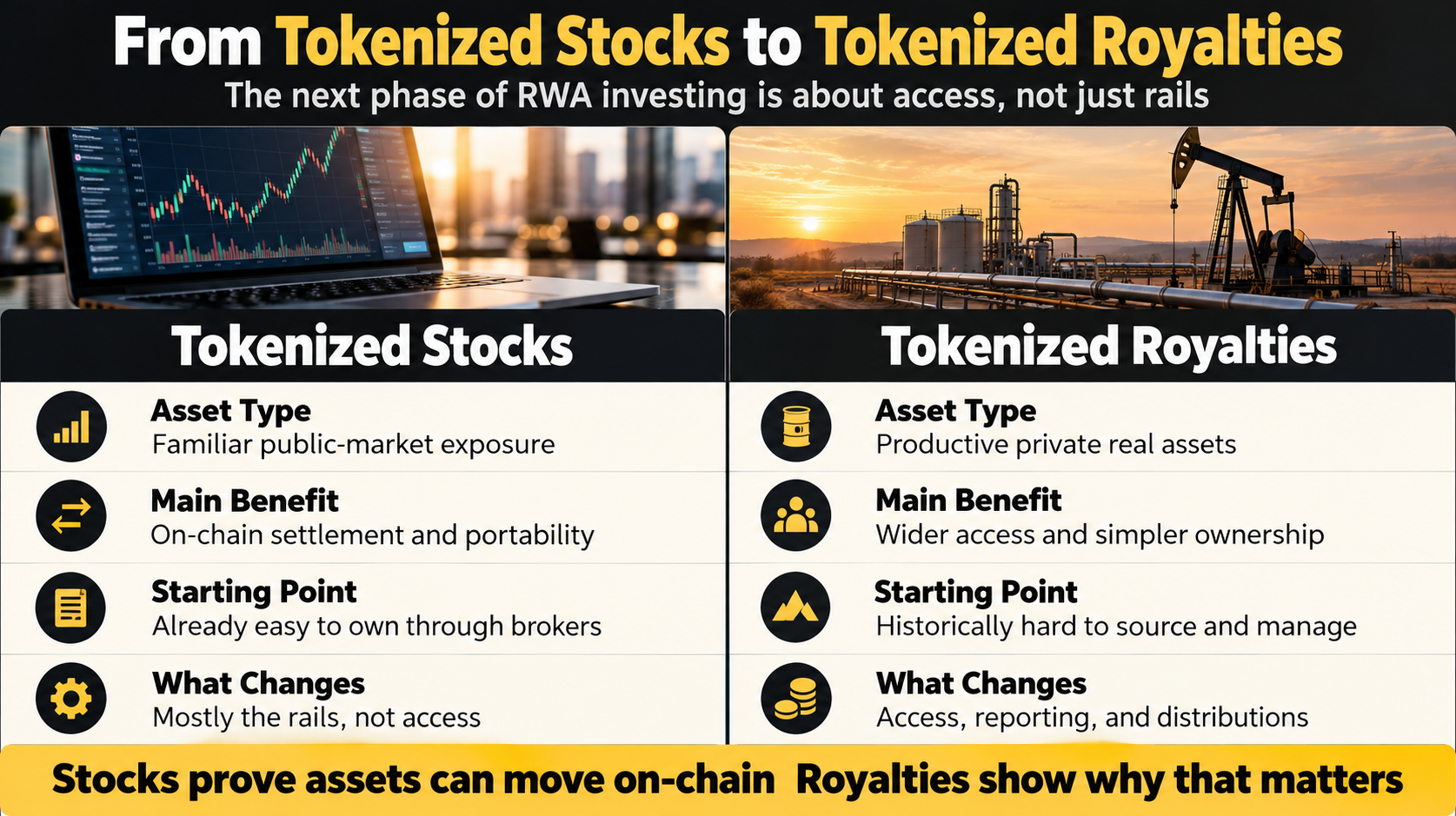
But tokenized stocks may be more important as a proof point than as the final destination. Stocks are already broadly accessible, highly liquid, electronically settled, and supported by mature brokerage infrastructure. Moving them on-chain can improve portability, settlement, programmability, and global access, but the underlying asset was never especially difficult to own in the first place.
The more transformative use of tokenization begins when the underlying asset is valuable but historically hard to reach. That is where private real-world assets – including U.S. mineral and royalty interests – become especially interesting.
| The next phase of RWA investing is not simply about putting more familiar assets on-chain. It is about using blockchain infrastructure where access, ownership, reporting, and distribution have historically been the hardest. |
Tokenized Stocks Are Proving the Rails
The rapid growth of tokenized equities in 2026 is a meaningful signal. It tells us that investors are increasingly comfortable holding blockchain-based representations of traditional assets, interacting with digital wallets, settling through stablecoins, and moving investment exposure across on-chain venues.
It also demonstrates something more fundamental: investors care about the rights and economics behind a token, not merely the token itself. The U.S. Securities and Exchange Commission has emphasized that tokenized securities remain securities and that different tokenization structures can give holders different rights. A token can represent the security itself, an entitlement to an underlying security, or another form of economic exposure. The wrapper matters, but the legal and economic substance matters more.
That distinction is critical for the broader RWA market. A blockchain record does not automatically make an asset better. Tokenization becomes valuable when it improves the way a legitimate underlying asset is owned, transferred, administered, or understood.
Why the first wave focused on familiar assets
The earliest large-scale RWA categories were logical starting points: cash-like instruments, government debt, private credit, funds, and eventually public equities. Investors already understood how these assets worked. Tokenization could therefore focus on infrastructure – faster settlement, fractional access, programmable ownership, interoperability, and improved collateral utility – without requiring the market to learn an entirely new asset class at the same time.
Tokenized stocks fit that progression perfectly. Investors already know what Apple, Nvidia, or an equity index represents. The innovation is primarily in how that exposure can be packaged and moved.
That is an important stage of adoption, but it also highlights a limitation. If tokenization only recreates assets that investors can already buy with a few clicks through a conventional brokerage account, much of its value remains incremental rather than transformational.
The Next Phase: Tokenizing Access, Not Just Settlement
The bigger opportunity is to apply the same infrastructure to assets that have historically been constrained by geography, minimum investment size, fragmented ownership, manual administration, specialized underwriting, and limited transparency.
Those are the assets where tokenization can do more than modernize settlement. It can change the practical investment experience itself.
A useful test is simple: what friction existed before the token? If the asset was already easy to buy, easy to sell, easy to administer, and easy to understand, the token mainly changes the rails. If the asset was difficult to source, expensive to access, administratively cumbersome, and opaque after purchase, tokenization can potentially change the entire access model.
Why mineral royalties fit the RWA thesis unusually well
U.S. mineral and royalty interests are a strong example of this second category. They are interests in real property tied to the production of oil and natural gas. When production occurs, the mineral or royalty owner can receive a contractual share of the revenue. Unlike a working-interest owner, a royalty owner generally does not fund drilling and operating costs in proportion to the revenue interest.
The economic proposition is straightforward. The access model historically was not.
Private mineral ownership is highly fragmented. Individual interests can be spread across counties, states, operators, wells, leases, and title chains that require specialized expertise to evaluate. Building a diversified portfolio at meaningful scale can require substantial capital, title work, land knowledge, accounting infrastructure, operator relationships, and patience. For an investor outside the U.S. energy ecosystem, direct participation has been especially difficult.
This is exactly the kind of problem RWA tokenization is suited to address: not by changing what a mineral interest is, but by changing how an investor can access an interest in a professionally assembled portfolio of those assets.
From Price Exposure to Productive Cash Flow
There is another important difference between tokenized stocks and tokenized royalties. A tokenized stock typically gives the investor exposure to a familiar security whose value is driven primarily by the market value of the underlying company, with dividends where applicable. A tokenized royalty portfolio begins with cash generated by physical production.
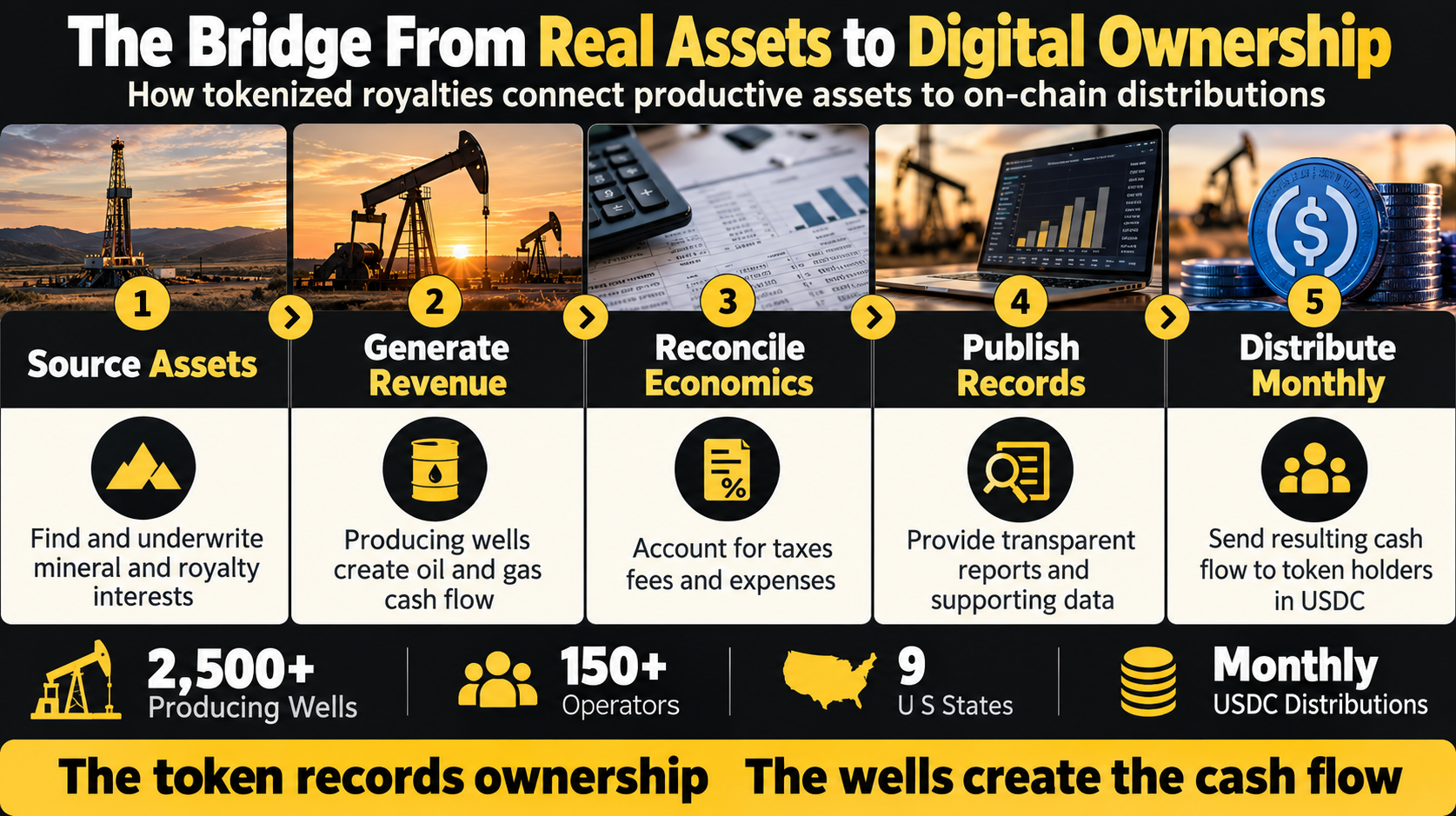
At Mineral Vault, the chain starts off-chain. Oil and natural gas are produced and sold. Purchasers and operators remit royalty revenue. Applicable property-level costs, taxes, and management fees are accounted for. The distributable amount is then paid to token holders through monthly USDC transfers.
The blockchain is therefore not the source of the yield. The wells are. Tokenization is the infrastructure that records ownership, streamlines distribution, and helps make the cash-flow trail easier to verify.
That distinction matters as the RWA market matures. The strongest RWA products will not be defined by how “crypto” they look. They will be defined by the quality of the asset, the clarity of the legal rights, the durability of the cash flow, and the transparency of the structure connecting the real-world asset to the token.
Mineral Vault I Shows What This Can Look Like in Practice
Mineral Vault I was built around this idea. The portfolio aggregates mineral and royalty exposure across more than 2,500 producing wells, more than 150 operators, 9 U.S. states, and over 10,000 gross acres. Nearly all of the underlying assets are already producing, so the investment begins with existing cash flow rather than a promise that future development must occur before distributions can start.
The first 15 months of actual cash flow published for Mineral Vault I, covering April 2025 through June 2026, totaled approximately $1.50 million net of management fees and before the effect of U.S. source-income tax withholding. Monthly distributions are delivered directly to token holders in USDC.
Just as important, each distribution is accompanied by a reporting trail. Mineral Vault publishes dividend reports, detailed summary spreadsheets, and supporting documentation for revenue and expenses through its Transparency portal. Investors can examine the off-chain cash flow and reconcile it with the on-chain distribution model.
That combination – real productive assets, digital ownership, direct-to-wallet cash distributions, and public supporting documentation – is a useful illustration of what the next phase of RWA investing can become.
The Real Innovation Is the Bridge
The phrase “real-world asset” can make it sound as if the token is the product. In reality, the most important work happens in the bridge between the physical asset and the digital instrument.
For tokenized royalties, that bridge includes:
- Property sourcing and underwriting before an asset enters the portfolio
- Title verification and legal documentation establishing the underlying rights
- A defined entity and assignment structure connecting property cash flow to the tokenized vehicle
- Ongoing collection and reconciliation of royalty revenue
- Accounting for applicable expenses, taxes, and management fees
- Monthly distribution of the resulting cash flow to token holders
- Transparent records that allow investors to follow the economics from asset to wallet
This is why the next stage of RWA competition may look less like a race to issue the most tokens and more like a race to build the most trustworthy bridges between real assets and on-chain ownership.
Tokenization Should Expand the Investable Universe
The long-term promise of tokenization is not simply that every asset will have a blockchain version. It is that the investable universe can become broader, more portable, and more transparent.
Tokenized stocks demonstrate how established financial assets can interact with blockchain rails. Tokenized Treasury products demonstrate how traditional yield can move on-chain. Tokenized private credit demonstrates how institutional lending exposures can be packaged digitally. The next logical step is to bring more productive, less accessible private assets into the same environment.
Mineral royalties belong in that conversation because the underlying asset is economically mature even if the access model has historically been inefficient. The U.S. mineral market has existed for generations. What is changing is the ability to package diversified exposure into a digital security with lower minimums, programmable distributions, and a more transparent ownership and reporting framework.
Liquidity matters – but it should not be confused with instant liquidity
One of the most attractive ideas in RWA tokenization is that an asset that was historically difficult to transfer can become easier to move between eligible investors. That is a meaningful improvement, but it is important to separate transferability from guaranteed liquidity.
A token can make compliant transfers more efficient and can create the technical foundation for secondary-market activity. It cannot guarantee that a buyer will always be available, that spreads will always be tight, or that every tokenized asset will trade like a large-cap stock. The depth of any secondary market will still depend on regulation, eligibility rules, investor participation, market infrastructure, and demand for the underlying asset.
For that reason, the best RWA thesis is not “tokenization makes everything liquid.” It is “tokenization can make historically cumbersome assets more transferable, more interoperable, and easier to administer while preserving the economic reality of the asset underneath.”
The Token Matters Less Than What It Represents
As more stocks, funds, credit products, commodities, real estate interests, and private assets move on-chain, investors will need a more sophisticated framework for comparing them. “RWA” will become too broad a label to say much on its own.
The questions that matter will look increasingly familiar:
- What exactly does the token represent?
- What legal rights does the holder have?
- What produces the underlying cash flow?
- What are the principal risks to that cash flow?
- How diversified is the underlying portfolio?
- What fees, taxes, and deductions apply?
- How transparent is the reporting?
- What happens if the tokenization platform, custodian, or service provider changes?
That is healthy. The maturation of RWA investing should move attention away from the novelty of tokenization and toward the quality of the asset and structure being tokenized.
What the next phase of RWA investing looks like
Tokenized stocks are an important milestone because they normalize the idea that conventional financial exposure can live on-chain. They also help regulators, institutions, exchanges, and investors learn how digital ownership can work at scale.
But the most consequential phase may come next. Once the rails are accepted, tokenization can be applied to assets where legacy finance has left more friction in place: private real estate, infrastructure, specialty credit, commodities, energy assets, and other cash-flowing property rights that have traditionally been reserved for institutions, insiders, or investors with large amounts of capital.
That is the opportunity Mineral Vault was designed around. We are not using blockchain to invent a new source of value. We are using it to open a long-established U.S. real-asset market in a more accessible, transparent, and programmable format.
| Tokenized stocks show that assets can move on-chain. Tokenized royalties show why some assets may be more valuable once they get there. |
Final Thoughts
The RWA market is moving quickly from proof of concept toward a broader question of portfolio construction. Investors will increasingly be able to hold public equities, fixed income, private credit, real estate, commodities, and alternative income assets within the same digital environment.
In that world, the winners will not necessarily be the assets with the most recognizable tickers. They may be the assets where tokenization creates the greatest difference between the old investment experience and the new one.
U.S. mineral royalties are a compelling example. They are backed by real property rights, linked to real energy production, capable of producing recurring cash flow, and historically difficult for most investors to access directly. Tokenization does not change those fundamentals. It makes them easier to reach, easier to administer, and easier to understand.
That is what the next phase of RWA investing should be about: not putting blockchain in front of every existing asset, but using blockchain where it can genuinely widen access to productive real-world value.
Disclaimer: This article is educational in nature and should not be considered investment, tax, or legal advice.
 Oil-Weighted vs. Gas-Weighted Mineral Interests: Why Commodity Mix Matters
  Passive Ownership, Active Operators: Why Operator Quality Matters in Mineral Investing
  Why Mineral Interests Are One of the Most Misunderstood Asset Classes in America