Most investors understand that oil and natural gas prices fluctuate differently. Fewer understand how that difference affects mineral and royalty interests.
A mineral portfolio is not just “energy exposure.” It can be oil-weighted, gas-weighted, or balanced between multiple revenue streams. That commodity mix can influence monthly royalty income, sensitivity to market cycles, upside from new development, and how the asset behaves inside a broader portfolio.
For investors evaluating mineral and royalty interests, commodity mix is one of the most important details to understand.
What does “oil-weighted” or “gas-weighted” mean?
When people describe a mineral interest as oil-weighted or gas-weighted, they are talking about the revenue mix of the underlying wells or acreage.
An oil-weighted mineral interest receives more of its revenue from crude oil and related liquids.
A gas-weighted mineral interest receives more of its revenue from natural gas production.
Some properties are clearly one or the other. Others produce a mix of crude oil, natural gas, and natural gas liquids. In a diversified mineral portfolio, different parts of the portfolio may have different commodity profiles.
That matters because oil and gas markets do not always move together.

Oil and gas respond to different market forces
Oil is a global commodity. Prices are influenced by worldwide supply and demand, OPEC+ decisions, geopolitical risk, shipping flows, refinery demand, inventories, and macroeconomic expectations.
Natural gas is more regional. In the United States, gas prices are heavily influenced by domestic production, weather, storage levels, pipeline constraints, power demand, industrial demand, and increasingly, LNG export demand.
This difference creates different risk and return patterns.
An oil-weighted royalty position may be more sensitive to global crude price cycles. A gas-weighted royalty position may be more sensitive to U.S. gas fundamentals, seasonal demand, and regional takeaway capacity.
Neither is automatically better. The right question is: what role is the commodity mix playing in the portfolio?
Why oil-weighted minerals can behave differently
Oil-weighted mineral interests are often attractive because crude oil is a globally traded commodity with deep markets and broad demand.
When oil prices rise, oil-weighted royalties can benefit because revenue is tied to the value of produced barrels. If production volumes remain steady and realized prices increase, royalty revenue can improve.
Oil-weighted properties can also be appealing in basins where operators are actively drilling because new wells may bring fresh production onto the acreage.
But oil-weighted exposure also comes with tradeoffs.
Oil prices can be volatile. Global supply decisions, geopolitical events, economic slowdowns, and changes in refinery demand can all affect crude pricing. A month with strong production can still produce weaker revenue if oil prices decline meaningfully.
For mineral owners, the key is not to assume oil exposure is always stronger. It is to understand how much of the portfolio’s royalty income depends on crude prices and how diversified that exposure is across wells, operators, and locations.
Why gas-weighted minerals deserve a closer look
Gas-weighted mineral interests are sometimes misunderstood because U.S. natural gas has historically been more regional and more volatile than oil.
Natural gas demand can shift sharply with weather. Warm winters can pressure prices. Hot summers can increase power demand. Pipeline constraints can create regional price differences. Production growth can temporarily overwhelm demand.
But the U.S. natural gas story is changing.
One of the biggest long-term shifts is the expansion of U.S. LNG exports. LNG allows U.S. natural gas to reach international markets, creating a stronger connection between domestic gas production and global gas demand.
The U.S. Energy Information Administration reported that U.S. LNG exports rose 23% in the first half of 2026 because of higher export capacity. EIA has also forecast that U.S. LNG exports will continue increasing as multiple LNG export projects start operations and ramp up production by the end of 2027.
That does not mean gas-weighted minerals are guaranteed to outperform. It does mean investors should not dismiss natural gas exposure as simply weaker oil exposure. It has its own demand drivers, infrastructure story, and long-term market logic.
Why LNG export expansion matters for gas-weighted royalties
LNG export growth matters because it can create additional demand for U.S. natural gas.
For gas-weighted mineral interests, this is relevant in several ways:
- Demand support: More LNG export capacity can increase demand for U.S. gas over time
- Regional effects: Gas-producing basins with access to pipelines and LNG demand centers may benefit more than constrained areas
- Operator activity: Stronger gas economics can influence where operators choose to drill and complete wells
- Price sensitivity: Gas-weighted royalties may become more exposed to global gas market conditions as LNG links U.S. supply to international demand
This is not a promise of higher distributions. LNG projects take time, pricing remains cyclical, and natural gas markets can still be oversupplied. But for investors evaluating commodity mix, LNG expansion is an important reason to pay attention to gas exposure rather than treating it as secondary.
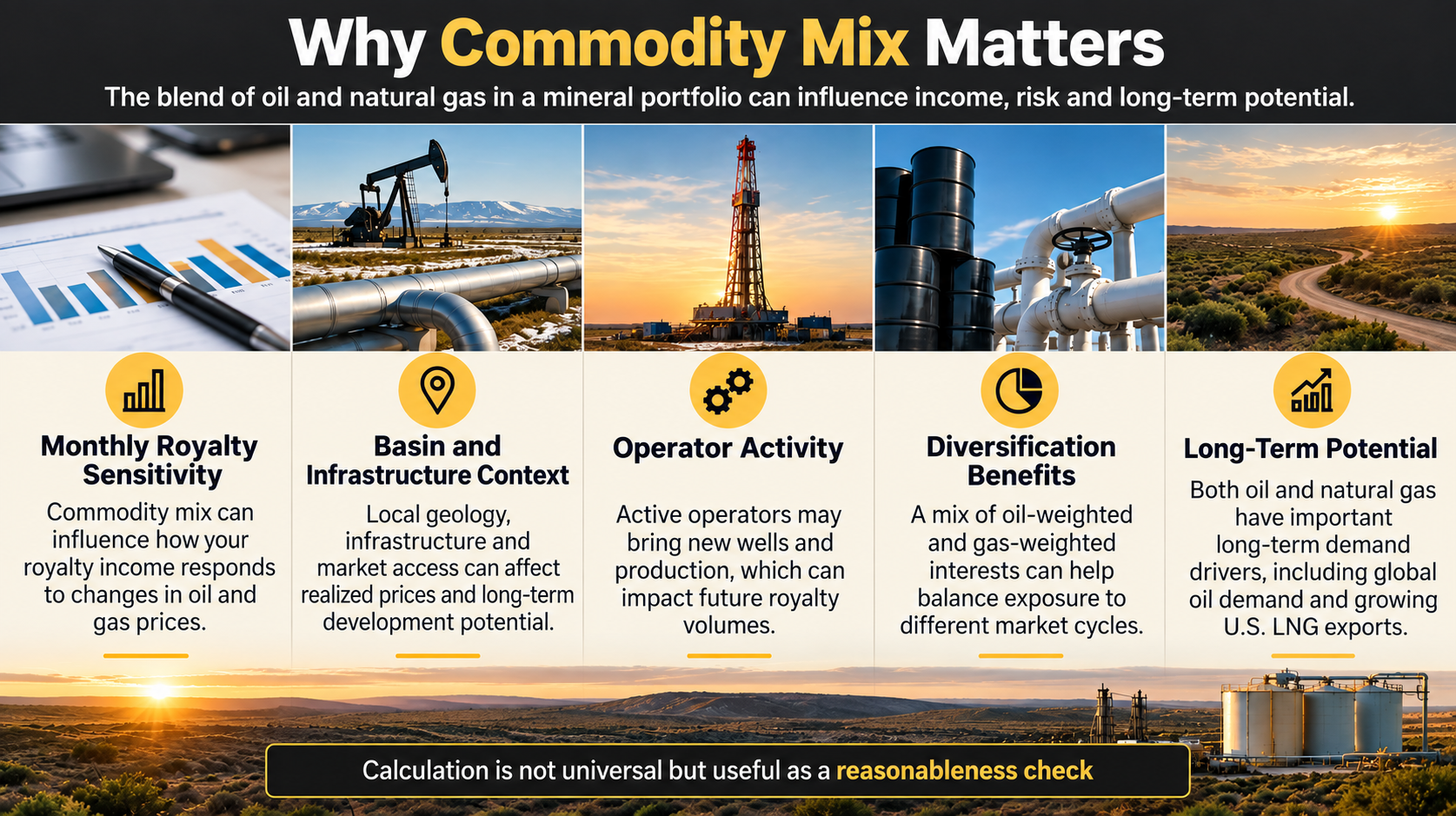
Commodity mix affects monthly distributions
Royalty distributions are driven by real production and real market prices. That means commodity mix can influence how monthly income moves.
An oil-weighted month may be affected most by crude prices and oil production volumes. A gas-weighted month may be affected more by Henry Hub prices, regional basis differentials, gas volumes, and seasonal demand.
A balanced portfolio may have multiple sources of movement at once. Oil prices might strengthen while natural gas weakens. Gas volumes might increase while oil production declines. Natural gas liquids may contribute differently than either crude oil or dry gas.
This is why royalty income should not be viewed like a fixed coupon.
A monthly distribution is the output of a real asset system. Commodity mix is one of the reasons that output changes.
Step 1: Identify the revenue source
The first step is simple: understand where the revenue is coming from.
Is the property mainly producing crude oil? Dry natural gas? Natural gas liquids? A mix?
This matters because oil and gas is not one single market. The production stream determines the pricing exposure.
Step 2: Look at basin and infrastructure context
Commodity mix is only part of the story. Location matters too.
A gas-weighted asset in a region with strong takeaway capacity may behave differently from gas production in a constrained basin. An oil-weighted asset in a highly active basin may have different future drilling potential than an isolated property with limited development activity.
For mineral investors, the questions should include:
- Which basin is this production tied to?
- Are operators actively developing nearby acreage?
- Is there pipeline or processing infrastructure available?
- Is the property exposed to oil, gas, liquids, or all three?
Step 3: Understand operator incentives
Operators make the decisions that turn acreage into production.
If gas prices are weak, some operators may slow drilling in gas-heavy areas. If LNG demand, power demand, or industrial demand improves the outlook, operators may become more willing to develop gas-weighted acreage.
Similarly, oil-weighted development depends on crude economics, service costs, capital discipline, and each operator’s inventory priorities.
Mineral owners are passive, but operator activity still matters.
Step 4: Evaluate diversification
A single oil-weighted or gas-weighted property can be exposed to one commodity, one operator, one basin, and one development plan.
A diversified mineral portfolio can reduce that concentration.
Diversification does not eliminate commodity risk. It can, however, prevent the entire royalty stream from depending on one product, one operator, or one regional market condition.
This is especially important when commodity markets are moving in different directions.
Key Takeaways
- Oil-weighted minerals tend to be more sensitive to crude oil prices and global oil market dynamics
- Gas-weighted minerals are more tied to U.S. natural gas fundamentals, weather, storage, infrastructure, and LNG demand
- U.S. LNG export expansion is an important reason investors should pay closer attention to gas-weighted mineral interests
- Commodity mix can influence monthly royalty distributions, future drilling potential, and portfolio behavior
- Neither oil-weighted nor gas-weighted exposure is automatically better; the right answer depends on asset quality, operator activity, diversification, and investor objectives
Where Mineral Vault fits in
Mineral Vault’s approach is built around the idea that mineral and royalty interests should be evaluated as real assets, not generic energy labels.
That means looking at production, operators, geography, title, development potential, revenue mix, expenses, and transparency. Commodity mix is one important part of that process.
Oil-weighted and gas-weighted mineral interests can both play a role in a modern royalty portfolio. The key is understanding what each one contributes and what risks each one introduces.
As U.S. energy production continues to evolve, and as LNG exports create new links between American natural gas and global demand, commodity mix will become even more important for investors evaluating mineral and royalty exposure.
Final thought
Mineral interests are often described broadly as oil and gas assets. But the details matter.
An oil-weighted mineral interest and a gas-weighted mineral interest can behave differently, respond to different market forces, and play different roles in a portfolio. Investors do not need to predict every move in commodity prices, but they do need to understand what their royalty income is tied to.
Commodity mix should not be a footnote for a mineral portfolio. It is one of the most critical considerations when building long-term, sustainable oil & gas asset portfolios.
Disclaimer: This article is for informational purposes only and does not constitute investment, legal, tax, or accounting advice. Mineral and royalty investments involve risk, including commodity price risk, production risk, operator risk, liquidity risk, tax risk, and possible loss of principal. Any investment decision should be made only after reviewing the applicable offering documents and disclosures.
 Passive Ownership, Active Operators: Why Operator Quality Matters in Mineral Investing
  Why Mineral Interests Are One of the Most Misunderstood Asset Classes in America
  What Actually Determines a Royalty Distribution Month to Month?