One of the most appealing features of mineral and royalty ownership is its passive structure. The mineral owner does not run drilling rigs, hire field crews, build gathering systems, or manage day-to-day well operations. When production occurs, the operator generally carries the operational burden while the mineral or royalty owner receives an agreed share of production revenue.
But passive ownership does not mean the underlying asset is passive. Every producing well is being managed by an active exploration and production company. That operator decides when to drill, how to complete a well, how aggressively to maintain production, when to repair or shut in equipment, and how to allocate capital across its inventory. Those choices can influence the timing, durability, and quality of royalty cash flow.
This is why operator quality matters in mineral investing. Mineral owners may not be writing drilling checks, but they are still economically connected to the companies making the operating decisions.
Key idea: Mineral ownership can be passive for the investor while remaining operationally intensive beneath the surface. The quality of the operator is one of the links between the property right and the cash flow it ultimately produces.
The mineral owner and the operator play very different roles
A mineral interest is a real property right in the subsurface estate. When that acreage is leased, an operator receives the right to explore for and produce hydrocarbons under the terms of the lease. In exchange, the mineral owner may receive a lease bonus and an ongoing royalty tied to production.
That division of responsibilities is fundamental. The operator supplies the technical expertise, capital, personnel, equipment, and infrastructure required to develop the resource. The mineral owner participates economically without taking on the same routine drilling and operating obligations associated with a working interest.
This structure is one reason mineral royalties can serve as an attractive form of real-asset income. It is also why the identity and quality of the operator deserve careful attention. The mineral owner is passive, but the operator is not interchangeable. Two companies can hold leases in similar geology and still produce different outcomes because of differences in capital strength, technical execution, operating discipline, infrastructure access, and development strategy.
Operator quality begins with capital allocation
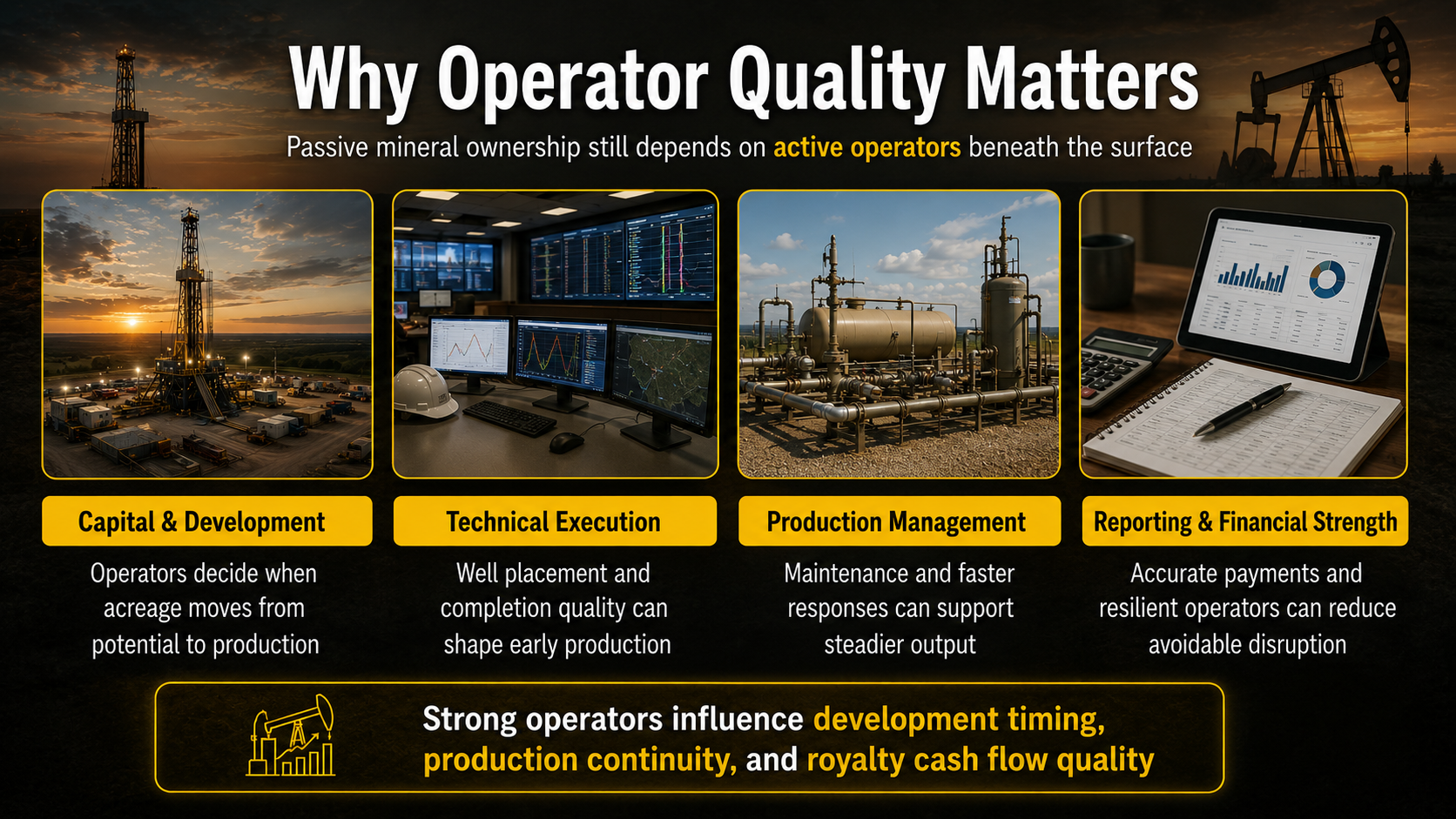
Undeveloped acreage does not create royalty income simply because hydrocarbons may be present. An operator must choose to commit capital, obtain permits, drill the well, complete it, connect it to infrastructure, and place it into production. The timing of those decisions is rarely automatic.
Operators continually rank drilling opportunities against the rest of their inventory. Commodity prices matter, but so do expected well economics, service costs, available crews, pipeline capacity, corporate debt levels, and broader capital-allocation priorities. A well may be technically attractive and still remain undeveloped if the operator has stronger opportunities elsewhere or lacks the financial flexibility to move forward.
For a mineral owner, this means operator quality is partly about whether the company has both the ability and the willingness to develop the acreage responsibly. A well-capitalized operator with a strong inventory position may be better equipped to maintain a consistent development program through changing market conditions. A financially constrained operator may delay completions, reduce activity, sell assets, or focus only on the most immediate needs.
This is especially important when evaluating future drilling potential. Undeveloped acreage can provide meaningful upside, but that potential becomes cash flow only when a capable operator converts it into producing wells.
Drilling and completion quality affect the production profile
Bringing a well online is not a standardized manufacturing process. Geological interpretation, well placement, lateral length, completion design, spacing, equipment selection, and field execution can all affect how a new well performs. Even within the same basin, operators can achieve different results from comparable acreage.
The U.S. Energy Information Administration has repeatedly documented that drilling efficiency and new-well productivity are major drivers of U.S. production. Operators have improved output through longer laterals, optimized completion designs, multi-well development, and more efficient use of crews and equipment. Those improvements do not remove geological risk, but they show how technical and operational capability can influence the value created from an acreage position.
For royalty owners, better execution can mean stronger initial production, a more efficient path from drilling to first sales, and a more productive use of the underlying resource. Poor execution can mean delays, cost pressure for the operator, underperforming wells, or development plans that fail to capture the acreage’s full potential.
The royalty owner may not pay the drilling bill, but the quality of that drilling still matters.
Good operators manage existing production, not just new wells
Operator quality is often discussed only in the context of drilling. Yet most royalty income in a producing portfolio comes from wells that are already online. Managing those wells well can be just as important as drilling the next one.
Producing assets require monitoring, maintenance, repairs, pressure management, artificial-lift optimization, gathering coordination, and responses to weather or equipment failures. Wells may be temporarily shut in because of mechanical issues, pipeline constraints, maintenance, or market conditions. How quickly and effectively an operator responds can affect production continuity.
No operator can eliminate downtime or natural decline. The question is whether the company has the systems, field presence, technical staff, and financial resources to manage those realities responsibly. Strong operators tend to treat production optimization as an ongoing process rather than simply drilling a well and moving on.
For the mineral owner, that discipline can show up in steadier production, faster recovery from interruptions, and a more durable stream of royalty revenue over time.
Reporting and payment discipline are part of operator quality
Royalty income depends not only on what is produced, but also on how accurately and promptly that production is measured, reported, allocated, and paid. Operators and purchasers must track volumes, product types, ownership decimals, sales values, deductions, and production months across large numbers of wells and interest owners.
That process is complex, and timing differences are normal. Government production datasets themselves can be revised when operators report late or when allocations change. For private royalty owners, delayed statements, suspense balances, ownership changes, or accounting corrections can affect when revenue appears even if the underlying well continued to produce.
A quality operator maintains strong revenue-accounting systems, responds to ownership documentation, handles division orders carefully, and communicates when issues arise. That does not guarantee perfectly uniform payments, but it reduces avoidable friction between production at the wellhead and cash reaching the owner.
This is one reason a royalty distribution can vary month to month without signaling a fundamental problem. Sometimes the cause is commodity pricing or production. Sometimes it is simply the timing of operator reporting and remittance. Understanding the operator base helps investors interpret those movements more intelligently.
Financial strength matters through commodity cycles
Oil and gas development is capital intensive. Operators fund drilling programs, field operations, infrastructure commitments, regulatory compliance, and eventual plugging and reclamation obligations. Their capacity to meet those obligations can change as commodity prices, service costs, interest rates, and capital markets move.
A financially resilient operator may be better positioned to continue maintenance and selected development during a downturn. A weaker operator may cut activity sharply, defer work, sell properties, or in severe cases enter bankruptcy. The existence of state and federal orphan-well programs is a reminder that operator responsibility continues long after first production and that financial capacity is not merely an abstract corporate metric.
For mineral investors, this does not mean only the largest companies are acceptable. Many private and independent operators have deep basin expertise, disciplined balance sheets, and excellent execution records. It means operator evaluation should consider financial durability alongside geology and current production.
Regulatory and environmental performance cannot be separated from economics
Operators are responsible for complying with permits, production-measurement rules, safety requirements, environmental standards, plugging obligations, and site-reclamation requirements. Regulators inspect operations and can issue notices, penalties, or orders when operators fail to comply.
For a passive mineral owner, those responsibilities may feel distant, but poor compliance can still affect the asset. Regulatory problems can delay development, interrupt production, create disputes, or make a property less attractive to future buyers and operators. Strong compliance practices support the long-term integrity of the acreage and reduce the risk that preventable operating failures interfere with production.
Responsible operation is therefore not separate from investment quality. It’s part of it.
Operator size is not the same as operator quality
It is tempting to reduce operator analysis to a familiar-name test. Large public companies often bring substantial capital, sophisticated engineering teams, established systems, and access to infrastructure. Those are meaningful advantages, but size alone does not answer every question.
A smaller operator may have sharper local knowledge, a concentrated position in one basin, lower overhead, or a stronger incentive to develop a particular set of properties. A large operator may control excellent acreage but rank it below other projects in its global portfolio. A private operator may move quickly, while another may be financially stretched. A public company may have strong resources, while its development cadence shifts with shareholder-return priorities.
The better questions are more specific: Does the operator have a proven record in the basin? Is it financially capable? Does it drill and complete wells efficiently? Does it maintain existing production? Is it developing the acreage at a rational pace? Does it report and pay accurately? Does it operate responsibly?
Operator quality is a collection of behaviors and capabilities, not a logo.
Why operator diversification matters
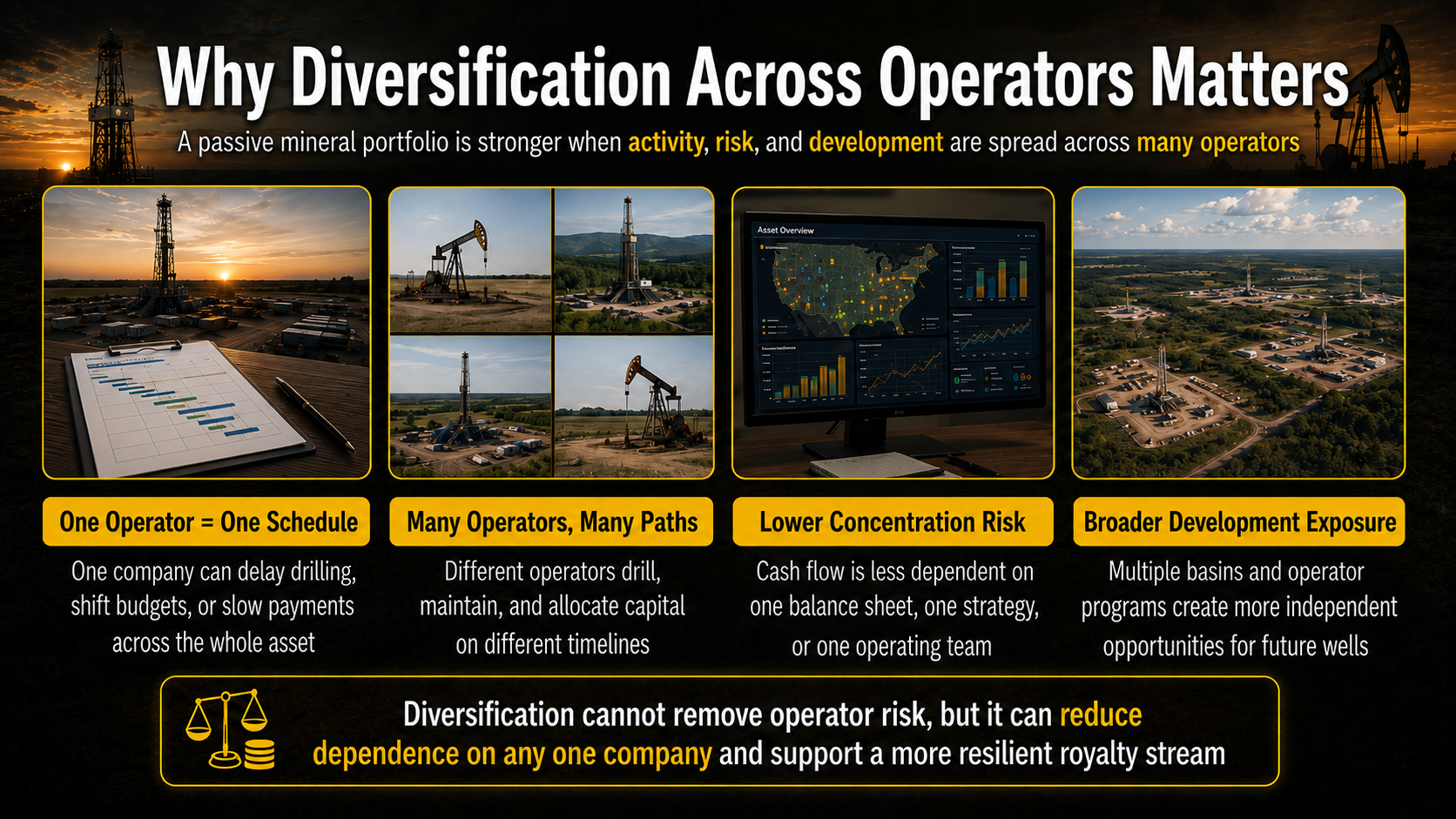
Even a high-quality operator can change its budget, sell assets, experience delays, or shift its priorities. That is why operator quality and operator diversification should be considered together.
A portfolio tied to one operator is exposed to that company’s development calendar, balance sheet, operational decisions, and reporting systems. If the operator slows activity or encounters problems, the effects can be felt across the entire asset base. A portfolio spread across many operators is less dependent on any single corporate decision.
Mineral Vault I is tied to more than 2,500 producing wells, more than 10,000 gross acres, over 150 operators, and 9 U.S. states. That operator breadth is important for two reasons. First, it reduces concentration risk. Second, it creates multiple independent paths for future development. Different operators allocate capital on different schedules, work in different basins, and respond differently to market conditions. Activity may slow in one part of the portfolio while continuing elsewhere.
Diversification does not make every operator equal and does not remove operating risk. It prevents the entire royalty stream from resting on the quality or decisions of one company.
How operator quality fits into Mineral Vault’s property selection
Mineral Vault I was assembled through more than 350 individual transactions across a broad set of producing properties. The evaluation process did not focus only on current revenue or the number of existing wells. It also considered basin geography, future development potential, property concentration, and the quality of the operators responsible for turning subsurface resources into production.
Emphasis was placed on established exploration and production companies with demonstrated operating track records. At the same time, the portfolio was intentionally diversified across more than 150 operators so that no single company would define the entire outcome.
That combination is important. Current production shows that an asset is already generating revenue. Future drilling potential creates the possibility of reserve replacement as older wells decline. Operator quality helps determine how effectively and when that future potential may be developed. Operator diversification reduces dependence on any one development plan.
In other words, good mineral underwriting is not simply a search for acreage. It is an assessment of the property, the production, the development runway, and the companies responsible for operating the wells.
How operator decisions appear in monthly royalty distributions
Operator quality is not always visible in a single monthly payment. Commodity prices can rise or fall. Wells can experience temporary downtime. Payments can shift between reporting periods. One operator may bring a new well online while another completes maintenance or delays a remittance.
Over time, however, operator behavior becomes part of the portfolio’s cash-flow pattern. Development activity can add new production. Effective maintenance can preserve output from mature wells. Efficient completions can improve the economics of new wells. Accurate reporting and timely remittance can reduce accounting noise. Financial strength can support continuity through weaker markets.
This is why investors should not evaluate a royalty portfolio by looking only at a headline well count or one month of distributions. The more useful questions are how the operator base is composed, how concentrated it is, how active those operators are, and whether the acreage has credible development potential under their stewardship.
Passive ownership works because active operators do the work
The passive nature of mineral ownership is not a contradiction. It is the result of a division of labor. The mineral owner supplies the property right. The operator supplies the capital, expertise, infrastructure, and day-to-day execution required to produce the resource.
When that relationship works well, mineral owners can participate in production revenue without becoming oil and gas operators themselves. But the quality of the active party still matters to the passive party. A royalty interest does not operate the well, yet its value is connected to how that well and the surrounding acreage are developed and managed.
Tokenization can make ownership easier to access, track, and transfer. It can make distributions and supporting documentation more transparent. It does not replace the importance of the underlying operators. The quality of a tokenized real-world asset still begins with the quality of the real-world activity beneath it.
Key takeaways
- Mineral and royalty owners can receive production-linked income without directly operating wells or funding the same routine drilling costs associated with working interests.
- Operator quality matters because operators control development timing, drilling and completion execution, maintenance, production continuity, reporting, compliance, and long-term asset stewardship.
- Financial strength is important, but operator size alone is not a complete measure of quality. Basin expertise, execution history, reporting discipline, and responsible operations also matter.
- Operator diversification reduces dependence on a single company’s budget, strategy, balance sheet, and development calendar.
- Mineral Vault I combines exposure to more than 150 operators with more than 2,500 producing wells across 9 states, helping create a broader and less concentrated royalty base.
- Tokenization modernizes access and administration, but the economics still depend on real properties managed by real operators.
Final thought
Mineral investing is often described as passive, and from the owner’s perspective, that description is largely accurate. The owner does not need to operate rigs, manage crews, or make daily field decisions.
But every royalty check begins with an active operator making hundreds of decisions beneath the surface and across the field. The best mineral portfolios recognize that reality. They seek quality operators, diversify across many of them, and pair current production with credible future development potential.
Passive ownership is most powerful when the active operators behind it are capable, disciplined, and diversified.
Disclaimer: This article is educational in nature and should not be considered investment, tax, or legal advice. Target outcomes and future development are not guaranteed, and mineral and royalty investments remain subject to commodity, production, operator, legal, tax, liquidity, and other risks.
 From Tokenized Stocks to Tokenized Royalties: What the Next Phase of RWA Investing Looks Like
  Oil-Weighted vs. Gas-Weighted Mineral Interests: Why Commodity Mix Matters
  Why Mineral Interests Are One of the Most Misunderstood Asset Classes in America